
Scaling Expertise – Article 1
Every Firm Has One Person It Can’t Afford to Lose
Every professional organization has one.
The attorney everyone consults before filing an unusual motion. The partner who knows exactly how a complex transaction should be structured. The litigator who has refined an argument through years of experience. The assistant who remembers why a particular clause changed ten years ago.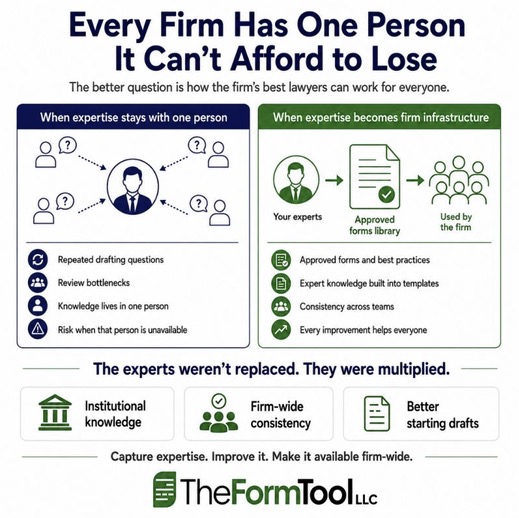
Ask around the office who would be hardest to replace, and you’ll usually hear the same names. Most firms accept that reality.
One firm we worked with decided to change it.
Instead of allowing expertise to remain inside individual lawyers, they asked a different question:
How can the firm’s best lawyers work for everyone?
It was one of the most important management ideas we’ve encountered in nearly twenty years working with professional document systems.
A Different Way of Thinking
The firm was large enough that it didn’t have one “best” lawyer. It had dozens. Each was recognized as an authority in a particular practice area. Estate planning. Litigation. Real estate. Corporate. Employment. Tax.
Traditionally, that kind of expertise creates dependence. Other lawyers ask questions. Drafts circulate for review. The experts become increasingly busy because everyone relies on them.
This firm chose another path. Each expert became responsible for developing and maintaining the firm’s best work product in that area. Not merely writing documents. Capturing judgment. Explaining choices. Refining language. Improving procedures.
The firm’s technical specialists then transformed that expertise into intelligent document systems that every lawyer could use.
The result was remarkable.
A young lawyer could begin with the same carefully developed knowledge that previously required years of experience—or a call to one of the firm’s experts. The experts continued improving the system. Everyone else benefited from every improvement.
Expertise Became Infrastructure
Most organizations think of expertise as something people possess. This firm treated expertise as infrastructure. That single shift changed everything.
Instead of answering the same drafting questions repeatedly, experts improved the underlying system. Instead of correcting recurring mistakes, they eliminated the conditions that caused them. Instead of becoming bottlenecks, they became architects.
Every improvement they made strengthened the work of hundreds of other lawyers. Expertise no longer flowed one conversation at a time. It became part of the firm’s daily operation.
The Real Asset
Many firms believe their greatest assets are their people. That’s certainly true. But there is another asset hiding inside those people. Their accumulated judgment. Their experience. Their understanding of what works—and why.
If that knowledge leaves when someone retires, changes firms, or simply goes on vacation, the organization loses far more than another employee. It loses part of its institutional memory.
The most successful organizations we’ve observed understand that expertise should be captured while it is available, refined while it is current, and continually improved by the people most qualified to improve it. Not because experts are replaceable. Because they are irreplaceable.
The Experts Were Multiplied
One detail from that firm’s experience has stayed with us. The experts never became less important. Quite the opposite. Their influence expanded dramatically. Instead of helping one lawyer at a time, they helped hundreds. Instead of reviewing the same issues repeatedly, they invested their time making the entire organization better.
Their expertise became available every day, on every matter, to every lawyer using the firm’s systems. The experts weren’t replaced.
They were multiplied.
An Unexpected Outcome
Years later, the lawyer who first championed this strategy has become one of the firm’s senior partners. Looking back, that isn’t surprising. He wasn’t proposing a better way to create documents. He was proposing a better way to manage knowledge. He recognized that the firm’s greatest competitive advantage wasn’t software. It wasn’t templates.
It wasn’t even its lawyers. It was the expertise those lawyers had accumulated over decades of practice. His insight was that expertise should become an institutional asset rather than remain an individual possession.
Every Firm Has One Person It Can’t Afford to Lose
Actually, every firm has many. The question isn’t whether those people exist. The question is whether their knowledge benefits only the people who know to ask—or whether it strengthens the entire organization.
The firms that will thrive over the next decade won’t simply hire outstanding professionals. They’ll find ways to capture, preserve, improve, and distribute the expertise those professionals develop. Because the greatest contribution an expert can make isn’t solving today’s problem.
It’s making tomorrow’s professionals better equipped to solve theirs.